Last Updated: October 23, 2026
Fixing the board that holds the gutter up
Gutter and fascia repair replaces the rotted fascia behind a gutter so the gutter can be hung on wood that will hold it. Gutters of Kent repairs the fascia behind the gutter line across Kent and South King County as part of gutter work, with the work done by licensed and insured contractors. It is a managed subservice of gutter repair and gutter replacement: the board gets fixed so the gutter job can be done right.
The scope is deliberately narrow. It covers the fascia that carries the gutter. Soffit panels, rafter tails, roof sheathing and general trim carpentry beyond the gutter line are not part of it, and roof repair is not offered. Where damage runs past the fascia, it is flagged so the right trade can deal with it.
Why the fascia matters to a gutter
A residential gutter hangs on its fascia. Hidden hangers clip inside the front lip of the gutter and screw through its back into the board, and a full run of wet debris and water puts a steady load on every one of them. Sound wood holds the screws for years. Soft wood lets them pull out, and the gutter sags, holds standing water, and sags further.
That is why new gutters are not hung on rotted fascia, and why adding screws to a sagging gutter on a soft board does not last. The fascia is checked before anything is re-hung, and the gutter hangers guide explains how hangers carry the load.
How fascia rots behind a gutter
Fascia rot comes from wood staying wet for long periods, and the gutter itself is often the source.
- Missing or short drip edge. Where the roof’s drip edge stops behind the gutter instead of lapping into it, water runs down the face of the fascia and behind the gutter every time it rains. The drip edge and gutter apron guide shows the difference.
- Overflow. A clogged gutter, too few outlets or a valley dumping into one corner sends water over the back as well as the front, soaking the board.
- Leaking joints. A failed end cap or corner drips onto the same few inches of wood all season.
- Standing water. A gutter pitched away from its outlet, or sagging between hangers, holds water against the board.
- Paint failure. Once the paint film cracks, especially on cut ends, water gets into the grain.
Kent’s climate gives each of those plenty of time to work. NOAA climate normals for the Kent station record 96.7 days a year with at least a tenth of an inch of rain, concentrated from October through January. A board that gets wet on nearly a hundred days and dries slowly in a cool, damp winter is the condition rot needs. The water behind gutters guide covers the roof-edge causes, and the overflowing gutters guide covers the rest.
What happens on the first visit
The walk-around measures each roof edge, checks the fascia and drip edge, and traces where every downspout lets go.
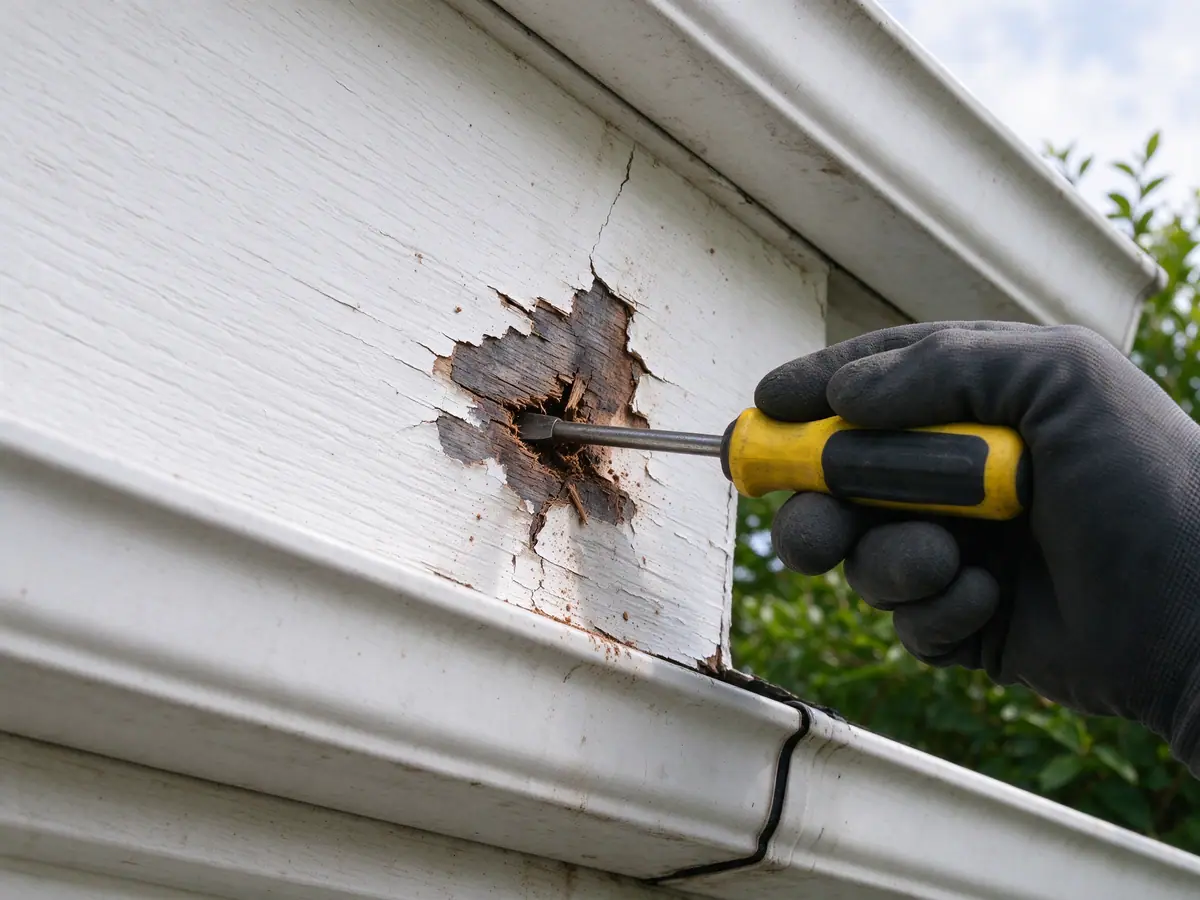
For fascia, the check goes past the paint. Peeling paint, staining below a corner, a gutter riding low at one spot or hangers backing out all suggest damage, but none of them proves it. The board is probed along the hanger line, and at a suspect spot the gutter may need to come down to see the full face and the back of the board. The drip edge above is checked, since a board replaced without fixing the cause will rot again.
The visit also looks for signs that damage has gone further than the fascia: a soffit stained or sagging below, soft wood at the ends of rafter tails, or roof decking that gives at the edge. Those are flagged plainly as outside this scope.
How the repair is done
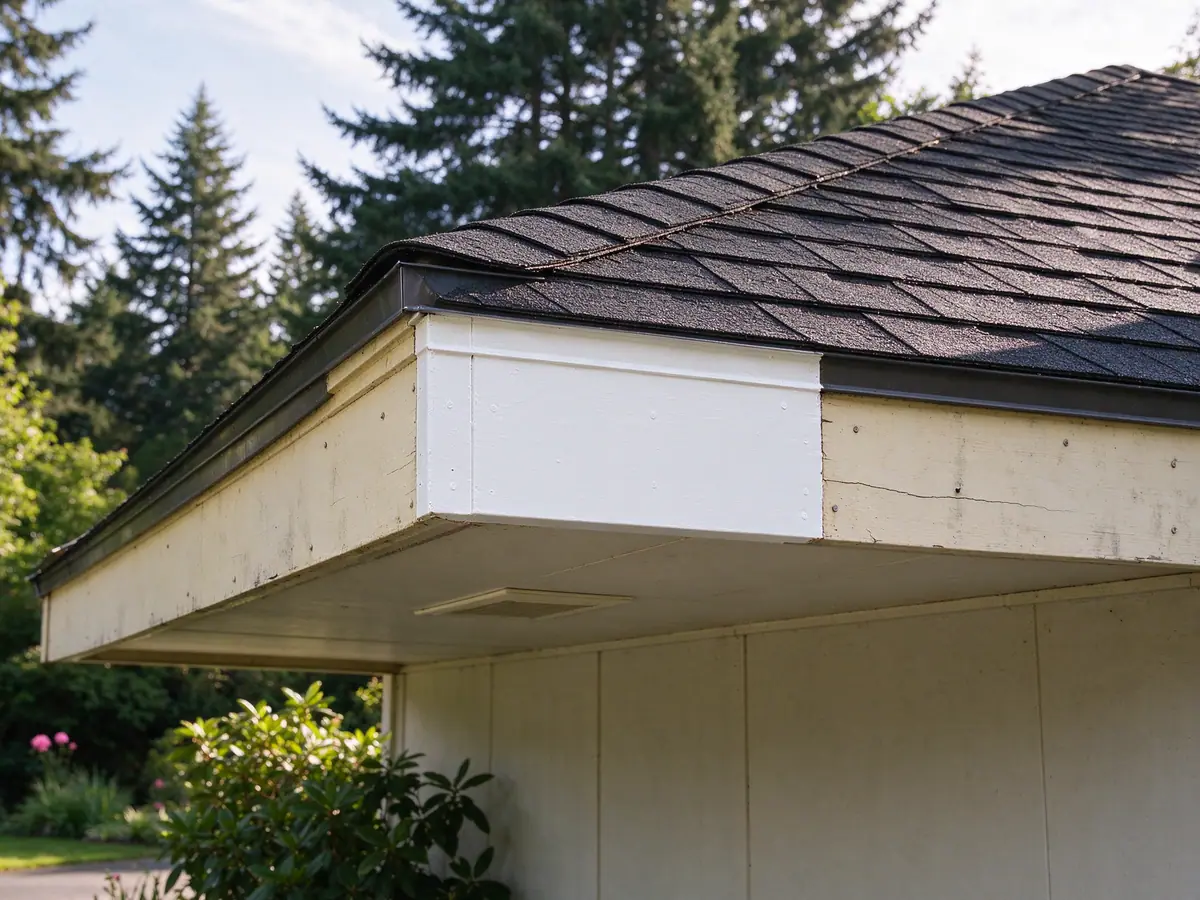
The gutter is taken down along the damaged stretch, and the rotted fascia is cut back to sound wood, with cuts placed over a rafter tail or solid backing so the new joint is supported. A new board of matching size is fitted, primed on all faces including the back and the cut ends, and fastened. Short local rot near a corner or end cap may mean replacing one section; long-term overflow along a run can mean replacing the fascia along the whole run, which is often done together with new gutters.
Then the cause is fixed. The drip edge is checked so it laps into the gutter. The leaking joint is resealed or replaced, the outlet reset, or a second outlet added where a valley overloads one corner. The gutter is re-hung on hidden hangers into the new or sound wood and pitched toward the outlets, and the repaired corners and outlets are water tested. Where a run was sagging along most of its length, sagging gutter repair covers the re-hang, and the why gutters sag guide explains the causes.
Where this scope stops
Some damage behind a gutter is beyond a fascia repair. Rot in rafter tails, roof sheathing or the first course of roofing, sagging soffits, and rotted trim on rakes and gables are carpentry or roofing work, and they are flagged for the appropriate trade. Wooden built-in gutters are a different job entirely, covered on box gutters.
Homeowners report trouble finding one contractor for fascia, soffit and gutters together, and asking whether gutter and roofing companies have to be coordinated. Here, the fascia behind the gutter is handled as part of the gutter work, and anything past it needs its own trade. American Community Survey data shows 38.5% of Kent homes were built before 1980, and a fascia board on a house that age may have been through decades of wet winters. Age is context, not a diagnosis: whether a given board is sound is something only the probe can tell.
What fascia repair costs
There is no reliable per-foot figure to publish for fascia repair. The price depends on how many linear feet of board are rotted, how many corners are involved, whether the gutter comes down on one stretch or the whole house, the height of the eave, and whether new gutters are going up at the same time. A second story adds ladder time: King County Assessor records show 45.0% of Kent houses are two-story. Washington sales tax applies to the whole contract, labor included, at 10.4% at most Kent addresses (WA Department of Revenue, WAC 458-20-170); the Department of Revenue’s tax rate lookup confirms an address.
When fascia repair goes with a full replacement, the Kent gutter installation cost guide covers the gutter side of the budget, and the gutter cost estimator gives a range for new gutters without a phone call. Before hiring, check the contractor with L&I: Washington requires every construction contractor to register, carry a bond and carry insurance.
What the work includes
- Walk-around that checks each run, the fascia and drip edge, and where each downspout lets go
- Removal of the gutter where the fascia behind it is damaged
- Probing of the board along the hanger line to find the extent of rot
- Replacement of rotted fascia sections behind the gutter line
- Priming of new boards, including cut ends and the back face
- Re-hanging the gutter on hidden hangers into sound wood, pitched to the outlets
- Correction of the leak or overflow that caused the rot
- Water test at the repaired corners and outlets
Fascia conditions behind a gutter and what each one means
| Condition | What it means | Typical scope | Outside this scope |
|---|---|---|---|
| Peeling paint, wood firm | Moisture at the surface, board still holds screws | Fix the leak or overflow, re-hang if needed | Repainting the house trim |
| Soft spots near a corner or end cap | Local rot from a leaking joint | Cut out and replace that section, then re-hang | None, if the rafter tail behind is sound |
| Soft board along much of a run | Long-term overflow or water behind the gutter | Replace the fascia along that run before new gutters | Soffit panels below it |
| Rot reaching rafter tails or roof sheathing | Water has gone past the fascia into the structure | Stop at the gutter line and flag it | Rafter, sheathing and roof repair by other trades |