Last Updated: October 23, 2026
Downspout extensions that put the water somewhere useful
A downspout extension carries roof water from the bottom elbow of a downspout out past the foundation, so the water from a whole roof plane does not land in one spot against the wall. Gutters of Kent installs downspout extensions and diverters across Kent and South King County, on houses, garages and commercial buildings, with the work done by licensed and insured contractors. That covers surface extensions, flip-up and roll-out sections, splash blocks, rain barrel diverters, and buried extensions joined to a drain line that is already in the ground.
This is a separate decision from the gutter itself. A sound gutter and a well-placed downspout still put every drop at one point, and the point is often a planting bed beside the foundation. NOAA climate normals give the Kent station 40.09 inches of rain a year, and November alone averages 6.23 inches. Each downspout carries its share of that, all winter, to the same few square feet.
Gutters and downspouts reduce the roof water that reaches the foundation, but they do not keep a basement dry on their own. Do gutters prevent basement water explains where that line falls. Yard drainage systems beyond the downspout tie-in, such as French drains, dry wells and regrading, are not offered.
What happens on the first visit
The walk-around measures each roof edge, checks the fascia and drip edge, and traces where every downspout lets go.
For an extension job the last part carries the most weight. Each downspout is followed from the gutter outlet to the ground, and the outlet is checked for three things: how much roof feeds it, where the ground goes from there, and what sits in the path, such as a walkway, a driveway, a neighbor’s fence or a window well. A downspout that disappears into the ground is traced as far as it can be, because the next decision depends on where that pipe ends.
The gutter above gets a look too. If a run is overflowing at a corner or pitched away from its outlet, an extension will carry away only part of the water, and the rest still falls at the wall. That is a gutter repair item, handled first. The gutter problem checker helps sort symptoms before the visit.
Kent’s rules for where downspout water can go
The rules set the edges of the job before any pipe is chosen.
Kent City Code 7.04.180(A) bars stormwater and roof runoff from the sanitary sewer unless the director authorizes it, and KCC chapter 7.14 sets the city’s illicit discharge and connection rules. A downspout that runs into a side sewer or a floor drain has to be rerouted, not extended.
Kent’s Surface Water Design Manual adopts the King County manual with Kent’s own changes. Under the King County manual Kent adopts, a splash block can disperse water from no more than 700 square feet of roof, and the water needs a vegetated flow path of at least 50 feet. Dispersion is not used near steep slopes or landslide hazard areas, or on slopes over 15%, without geotechnical approval. Any roof downspout tied to the local drainage system is to be connected through a perforated pipe connection.
KCC 7.05.070 requires a permit to construct, install or modify any storm or surface water drainage structure or facility in the city. A buried extension joined to an existing line is checked against that rule before work starts. For an extension that stays on the surface, confirm the current requirement with the City of Kent Permit Center. Where downspouts should drain covers the wider choices.
Valley floor or hillside: why the same extension behaves differently
Kent sits on two very different kinds of ground, and a downspout outlet behaves differently on each.
On the Green River valley floor the land is flat. City of Kent critical areas mapping puts 24.3% of the Green River region inside the FEMA flood zone, and the city describes its valley aquifer as recharged by direct infiltration through the land surface. Where a lot is that flat and the soil is already wet from a long rainy season, water from a short extension can sit in a sheet rather than move away. Extensions there tend to need more length, an outlet aimed at the lowest point of the yard, or a buried run into a line that is already there.
The hills are the opposite problem. The same mapping puts 13.8% of West Hill on landslide-hazard soils, and steep slopes cover 8.1% of the region. On a slope, a long extension can drop concentrated water onto ground that should not take it, which is why the King County manual keeps dispersion away from landslide hazards and slopes over 15% without a geotechnical sign-off. On a hillside lot the extension is planned around where the water ends up, not only how far it travels.
Between the two, a lot may have only a few feet of fall in one direction. The residential code asks for finished grade to fall away from the foundation, 6 inches within the first 10 feet (IRC R401.3), and where soil has settled back toward the wall an extension fights that slope. Regrading is not part of the scope, but it gets noted.
Choosing the extension for each downspout
Each downspout gets its own answer, because the yard around it is different on every side of the house.
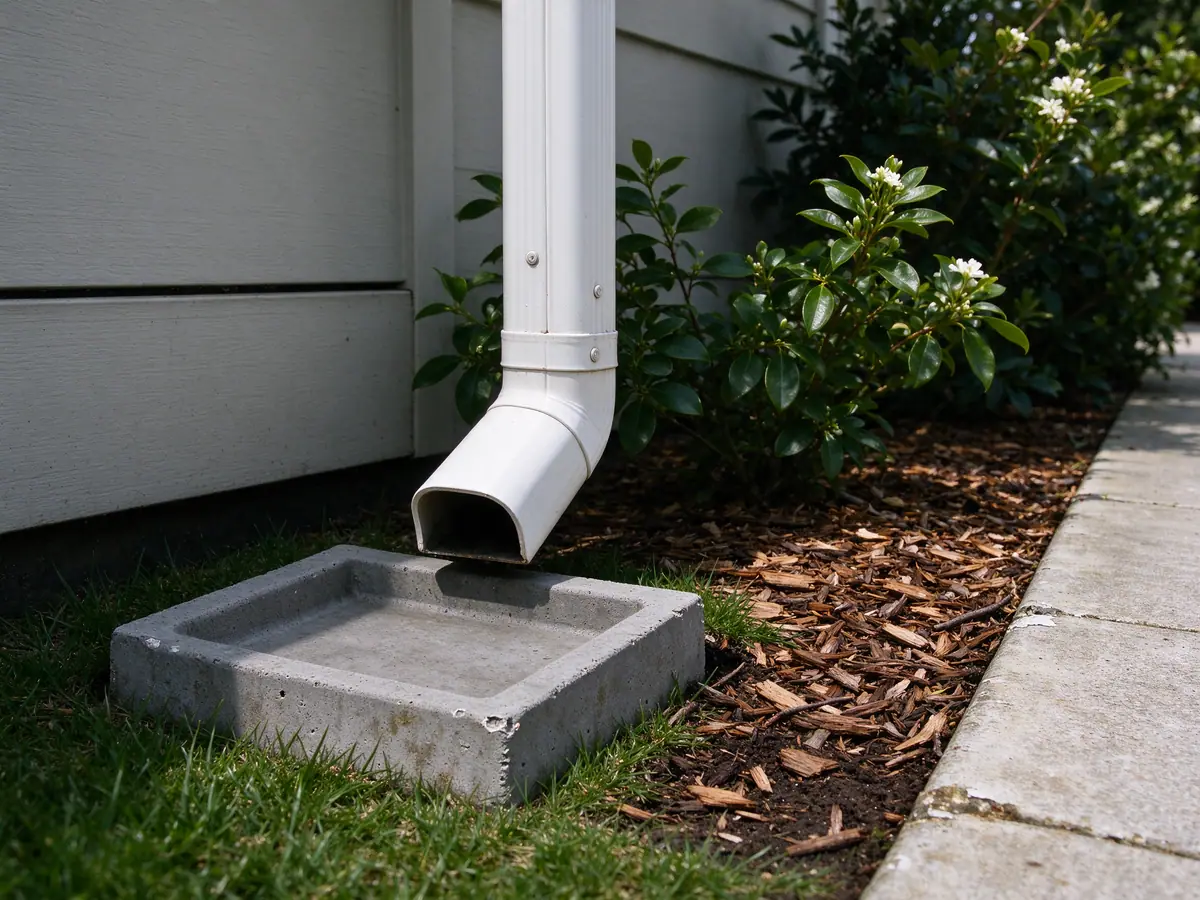
A splash block suits a small roof area over level ground with room to soak in, and nothing more. The 700 square foot limit in the King County manual rules it out for a long eave on a large roof.
A fixed surface extension is extra downspout pipe off the bottom elbow, sized to match: 2x3 pipe on a 2x3 downspout, 3x4 on a 3x4. It runs along a side yard or through a bed where nobody walks. The joint at the elbow is lapped so the upper piece sits inside the lower one and water stays in the pipe, then fastened so the extension does not twist loose. The downspout sizes guide covers the two common sizes.
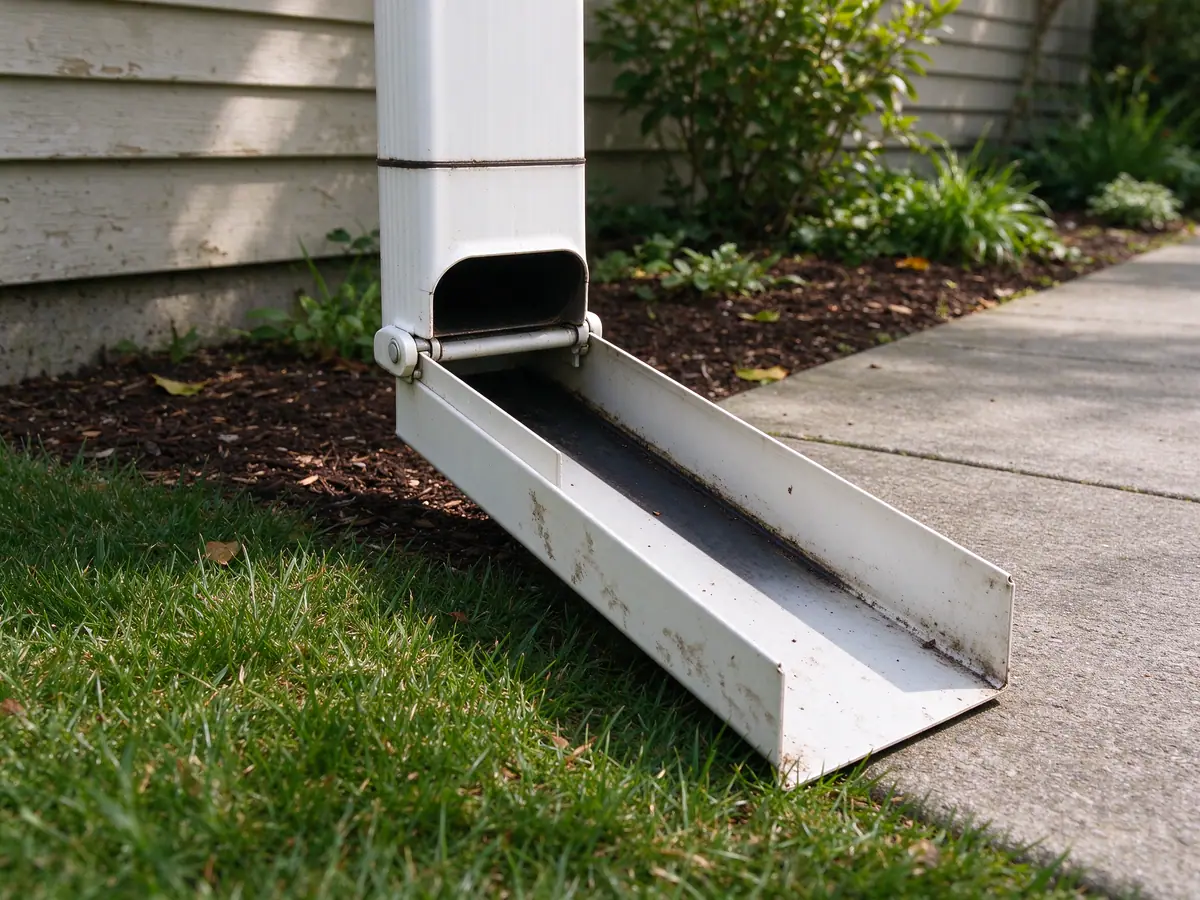
A flip-up extension has a hinge at the elbow, so it lifts out of the way for mowing and drops back down for rain. A roll-out sleeve unrolls when water fills it. Both only work when they are down, and sleeves tend to fill with roof grit, so they suit places where someone will notice.
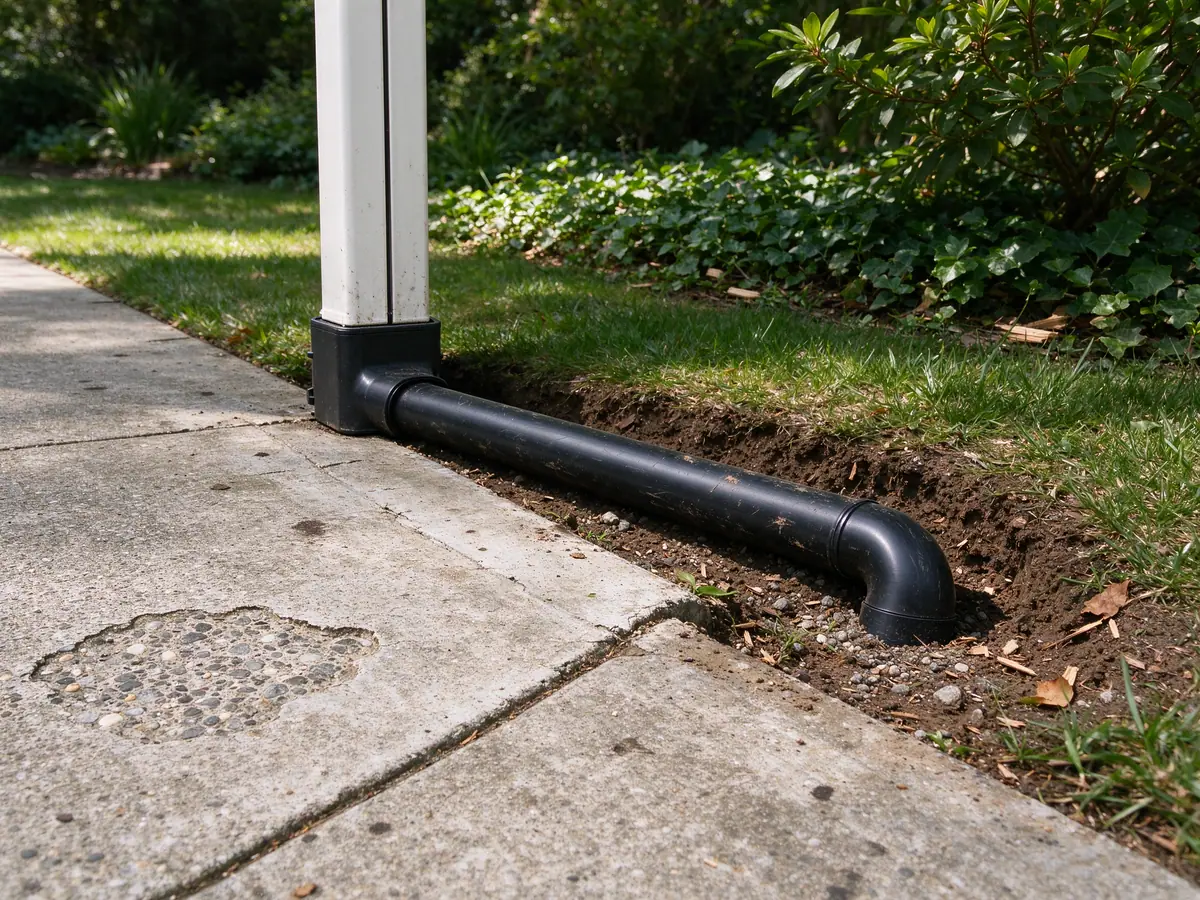
A buried extension to an existing line runs solid pipe from the downspout below grade to a line already in the ground, where a pipe on the surface would cross a driveway or walk. It is clean to look at, and a clog is hidden until water backs up the downspout. It only makes sense if the existing line is sound and ends somewhere legal. Underground downspout drains explains the clog and leak signs. Digging a new drain system across the yard is not offered.
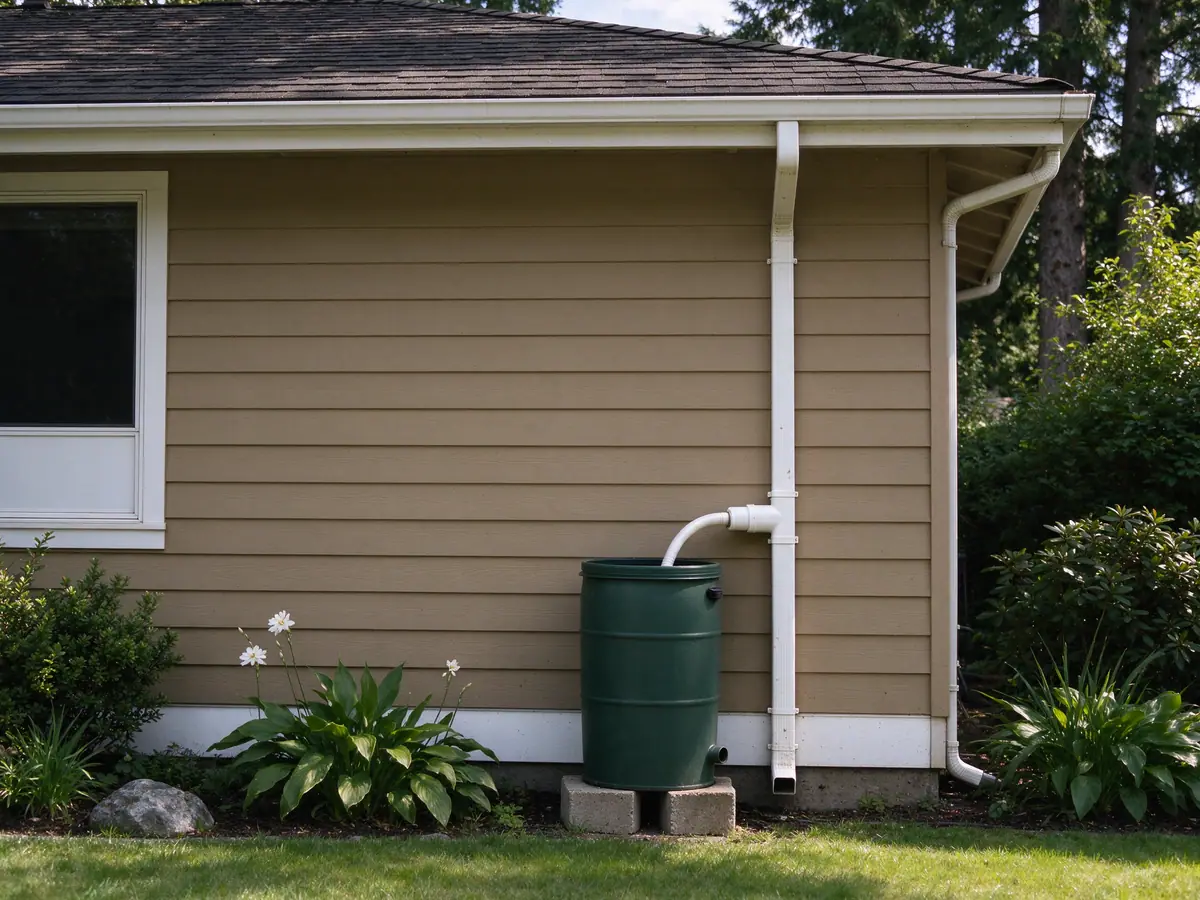
A rain barrel diverter is a fitting cut into the downspout that sends water to a barrel until it fills, then lets the rest continue down. NOAA normals show the reason it is popular and the reason overflow matters: Kent’s station averages 0.67 inches in July and 0.92 in August, but 6.23 in November. Rain barrels and downspouts covers fittings and overflow.
Where an extension is not the right fix
Some water at the wall has nothing to do with the extension. A gutter that spills over its front edge in a heavy rain needs another outlet or a cleared one, not a longer pipe at the bottom, and why gutters overflow sorts out the causes. A roof plane with too few downspouts sends too much water to each outlet; how many downspouts you need explains the spacing. Water running behind the gutter and down the siding is a drip edge or fascia question, covered under gutter and fascia repair and water behind gutters.
When a downspout is crushed, too small for the roof above it, or rusted through at the elbow, the downspout itself gets replaced with new downspouts rather than extended.
What downspout extensions cost in Kent
Extension work is priced by what each downspout needs, not by the foot of gutter. Standard aluminum downspouts carry a national budgeting range of about $30 to $75 per downspout; taller runs, copper and buried connections cost more. A surface extension or flip-up section adds pipe and an elbow to that. A buried extension adds digging, solid pipe, the joint into the existing line and any permit the connection needs. These are budgeting figures, not quotes.
The drivers are the number of downspouts, whether each one stays on the surface or goes underground, how far each has to travel, what has to be crossed, and the condition of any existing line. Washington sales tax applies to the whole contract, labor included, at 10.4% for most Kent addresses; the WA Department of Revenue’s tax rate lookup confirms the rate for a given address. The Kent gutter installation cost guide shows how the parts of a gutter job add up.
What the work includes
- Tracing where each existing downspout lets go
- Choice of surface, flip-up, roll-out or buried extension per downspout
- New elbows and extension pipe matched to 2x3 or 3x4 downspouts
- Splash blocks set where the roof area and flow path allow
- Rain barrel diverters fitted into the downspout where wanted
- Buried extension joined to an existing drain line, where the line is sound and permitted
- Straps and fasteners at the elbow so the extension stays aligned
- Water test through the gutter, downspout and extension
Ways to carry downspout water away from a Kent foundation
| Option | How it works | Fits best | Limits | Check first |
|---|---|---|---|---|
| Splash block | A shaped pad under the elbow spreads water onto the ground | Small roof areas over level ground with room to soak in | King County manual: up to 700 sq ft of roof per block and a 50 ft vegetated flow path | How much roof feeds that downspout |
| Fixed surface extension | Extra downspout pipe off the bottom elbow, laid on the ground | Side yards and beds where nothing crosses the outlet | A trip hazard on paths; gets kicked loose | Whether the ground falls away from the house |
| Flip-up or roll-out extension | A hinged section or flexible sleeve that lifts or unrolls | Lawns that get mowed and walkways used daily | Only works when it is down; sleeves clog with grit | Who will put it back down after mowing |
| Buried extension to an existing line | Solid pipe from the downspout into a drain line already in the ground | Driveways and walks where nothing can sit on the surface | The old line has to be sound; a clog is hidden | Where the line goes, its condition and the permit rule |
| Rain barrel diverter | A fitting cut into the downspout sends water to a barrel until it is full | Garden water in a dry summer | Overflow still needs a path away from the wall | Where the overflow and the downspout outlet go |